Zeta Reticuli

Tuna — Modern Launcher for macOS
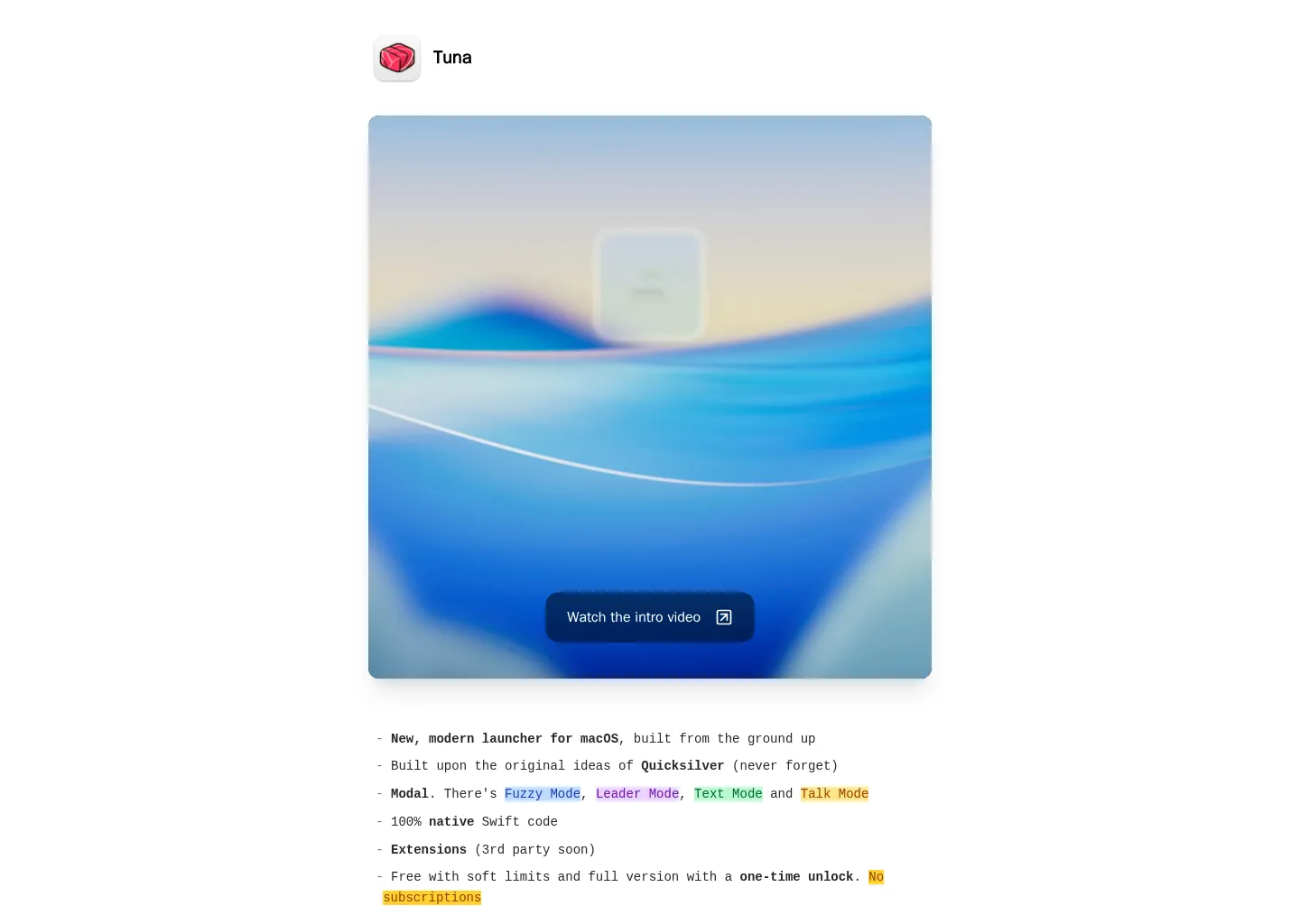
A new native macOS launcher built from the ground up in Swift, inspired by the original Quicksilver. Four modal modes: Fuzzy Mode for quick searches, Leader Mode for keyboard-driven commands, Text Mode for text manipulation, and Talk Mode (presumably voice input). Supports extensions with 3rd-party support coming soon. Free with soft limits, or one-time unlock for the full version—no subscriptions. Requires macOS 15 Sequoia or newer. Currently in beta. Built by mikker, who also made 10er. Another entry in the growing list of native Mac productivity tools that refuse to become subscription services—local-first, keyboard-driven, and respecting the Quicksilver lineage that defined power-user workflows on macOS.
Sets
Sherelle @ The Lot Radio (February 23, 2026)
UK DJ and producer Sherelle has been pushing jungle, breakbeat, and 160 BPM sounds to the forefront of dance music for years. Her sets are relentless, energetic affairs—precision mixing that builds tension through rapid-fire breakbeats, bassweight, and the kind of controlled chaos that makes jungle feel urgent and alive. She’s a co-founder of the BEAUTIFUL collective, championing underground sounds and underrepresented voices in electronic music. This live set from The Lot Radio captures her signature approach: high-tempo, genre-fluid, and uncompromising. If you want to understand why jungle never really went away, just got faster, this is a masterclass.
CLIAMP — Terminal Winamp
A retro terminal music player inspired by Winamp 2.x, complete with ASCII-rendered 10-band spectrum visualizer, 10-band parametric EQ with presets (Rock, Jazz, Bass Boost, etc.), and full playlist management. Plays MP3, WAV, FLAC, OGG, AAC, ALAC, Opus, and WMA. Supports HTTP streaming, M3U playlists, podcast RSS feeds, and Navidrome server integration. Built in Go with Bubbletea for the TUI. Keyboard-driven workflow with Vim-style navigation—space to play/pause, j/k for scrolling, h/l for EQ navigation, seek controls, volume up/down, shuffle, repeat modes. The kind of project that exists because someone missed the Winamp 2.x era enough to rebuild it for the terminal. Nostalgia meets modern terminal aesthetics. Zero subscriptions, infinite skinnability (if you count ASCII art).
https://github.com/bjarneo/cliamp
voxcii — ASCII 3D Model Viewer
A terminal-based 3D model viewer written in C++ that renders OBJ and STL files entirely in ASCII. Real-time 3D rendering with ASCII shading based on surface lighting, z-buffer for proper depth and occlusion, polygon triangulation for complex faces, and optional material colors from .mtl files. Interactive mode lets you rotate models with arrow keys, zoom with +/-, and the quality depends on your terminal size and font. Built with ncurses for the TUI. It’s the kind of project that exists because someone looked at 3D modeling software and thought “what if this ran in my terminal with ASCII characters?” The answer is surprisingly functional. Perfect for quickly previewing models without launching heavyweight 3D software, or just appreciating the aesthetic of wireframe-era graphics rendered in text.
https://github.com/ashish0kumar/voxcii
Lumen — AI Markdown Todo System
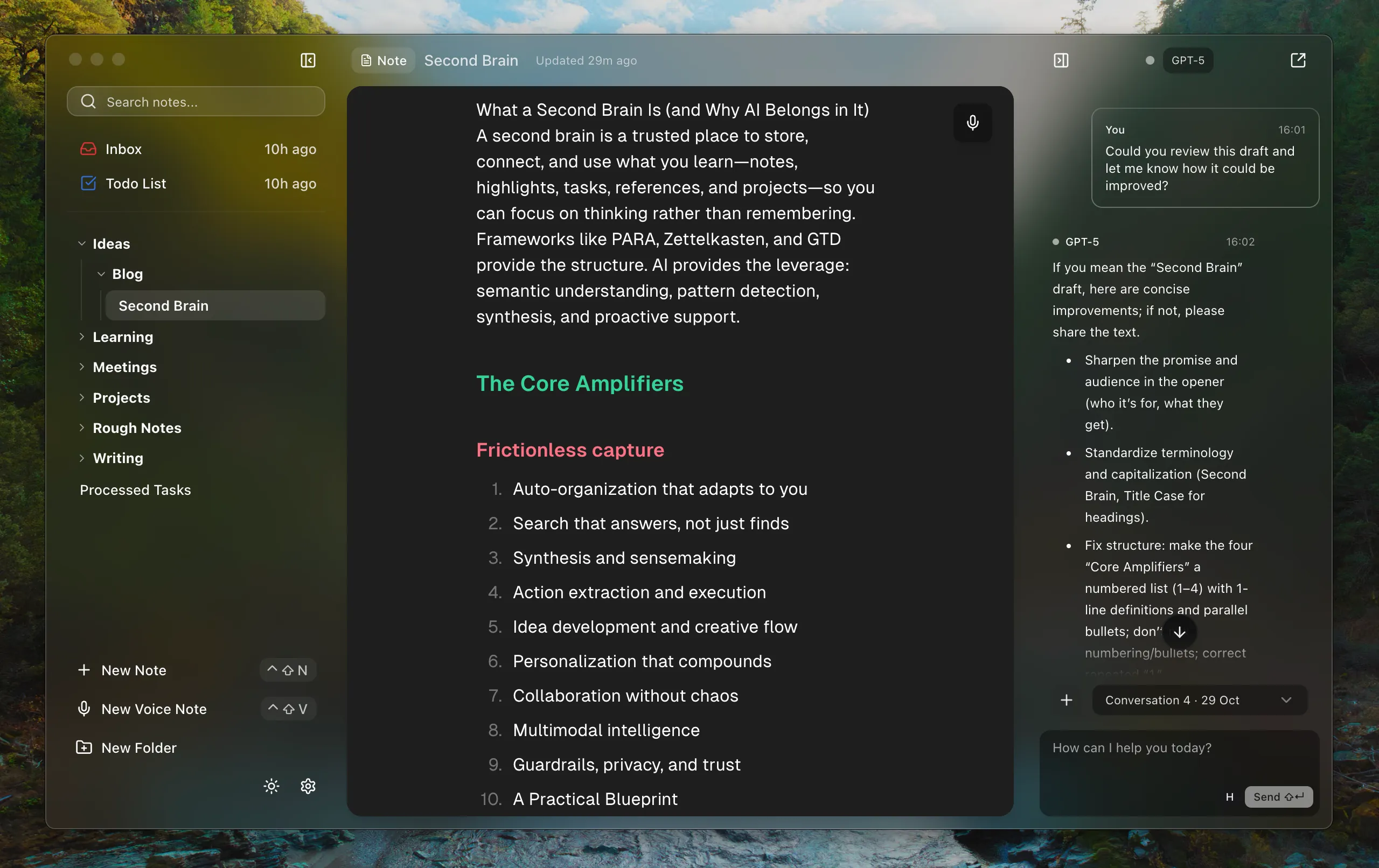
A minimalist macOS productivity app that combines notes, tasks, and ideas into one focused workspace, inspired by GTD, Obsidian, and Zettelkasten. Uses plain Markdown files stored locally (works with your existing Obsidian vault), no registration required, no vendor lock-in. The AI features are thoughtfully integrated: a self-healing todo list that auto-organizes based on structures like GTD, inbox processing that suggests categorization and asks clarifying questions, Cmd+H to bring any text from any app into AI chat for summarization or drafting, meeting recording with automatic transcription and action items. Beautiful markdown editor with note hyperlinks and backlinks, custom prompt library for reusable workflows. Privacy-first: requires your own OpenAI API keys (encrypted locally), no cloud middleman. Currently in beta. This is what happens when someone builds a productivity tool for themselves and refuses to compromise on local-first principles or turn it into a subscription trap. The anti-Notion.
Secure Snake Home (SSH) — Multiplayer Snake Over SSH
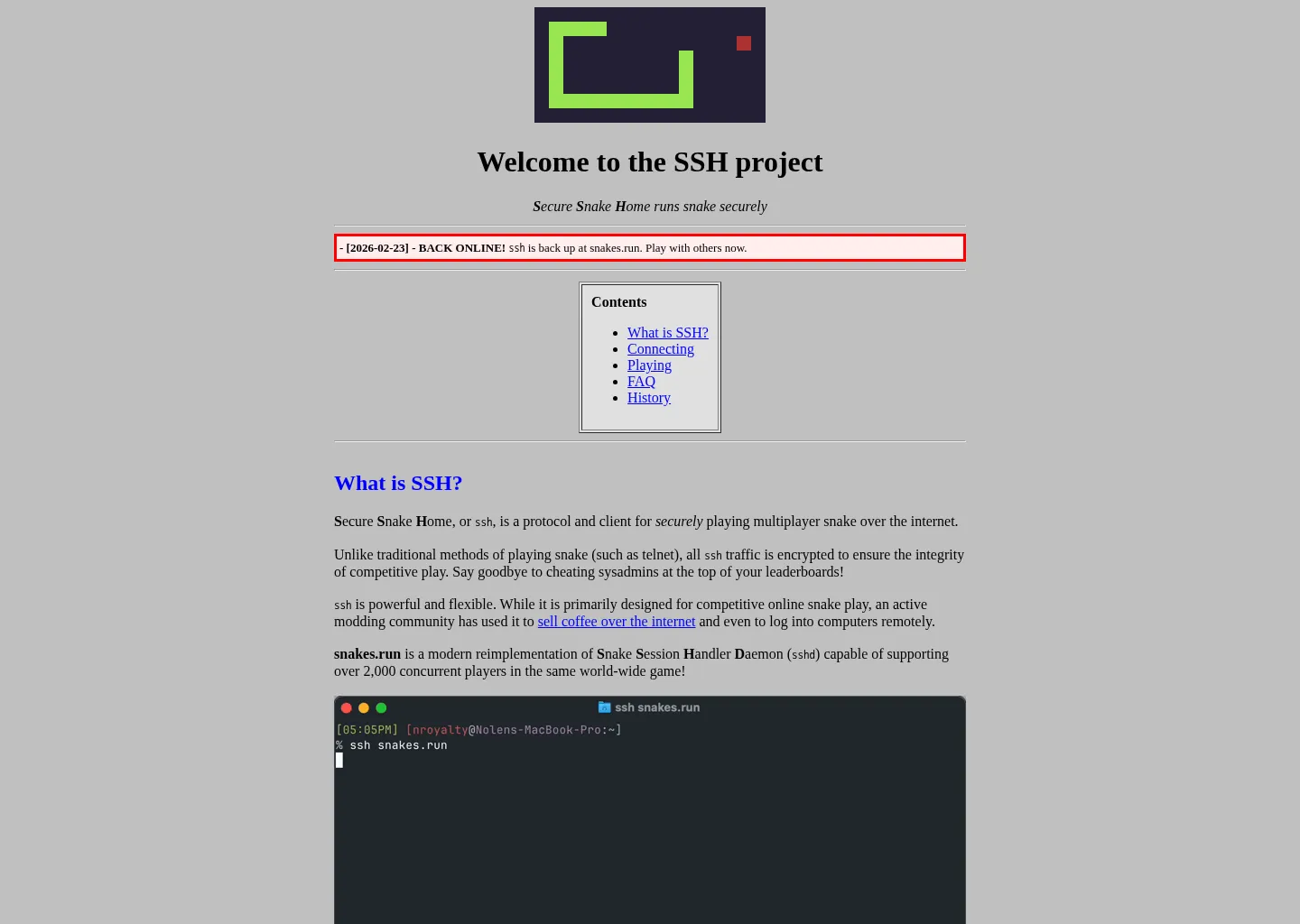
A satirical reimagining of SSH as “Secure Snake Home”—a protocol invented to prevent cheating in competitive online snake games. The entire site is written as alternate history: SSH wasn’t created for remote server access, it was created in 1995 by Tatu Ylonen (real SSH inventor) after MIT “pranked” CalTech during Collegiate Snake League finals by sniffing their telnet moves. The joke is meticulous: fake timeline spanning 1976-2026, references to “man in the middle” attacks (opponent seeing your moves), ssh-keyscan for server validation, and a modding community that “accidentally” started using it to log into computers remotely. But here’s the kicker—it’s a real working multiplayer snake game. Run ssh snakes.run in your terminal and you’re playing snake with thousands of concurrent players worldwide, built with Charm’s wish and bubbletea. The perfect intersection of technical achievement, absurdist humor, and “wait, this actually works” engineering. SSH was invented for snake. You can’t prove otherwise.
12 Principles of Animation (Official Full Series)
The foundational principles that have governed character animation since Disney animators Ollie Johnston and Frank Thomas codified them in The Illusion of Life (1981). Squash and stretch, anticipation, staging, straight ahead vs. pose-to-pose, follow through and overlapping action, slow in and slow out, arcs, secondary action, timing, exaggeration, solid drawing, and appeal—these aren’t just animation theory, they’re the DNA of movement in every animated film, game, and motion graphic you’ve ever seen. This official full series breaks down each principle with visual examples, showing why a bouncing ball needs squash and stretch to feel like it has weight, why anticipation (the wind-up before the punch) makes action readable, and why timing is the difference between comedy and drama. Essential viewing for anyone working in animation, motion design, UI animation, or just trying to understand why Pixar characters feel alive. The principles are nearly 50 years old and still unchallengeable.
Watched


Lifeforce (1985)
