Another Dimension

The Vibe-Coded Extinction Event
I’ve been watching something quietly play out across /r/macapps and /r/commandline over the past few months—a pattern that feels like the beginning of the end for an entire category of software. Open-source alternatives to paid menu bar utilities, screen recorders, and dictation apps are multiplying at an unnatural pace. Not because developers suddenly got more generous, but because the friction between “I wish this existed” and “here’s a working prototype” has collapsed to almost nothing.
These aren’t polished commercial products. They’re vibe-coded—spun up by someone who spent an afternoon with Claude or Cursor, patched together from examples and Stack Overflow fragments held together by LLM glue. They work just well enough. And crucially, they’re free.
The community’s reaction is telling. Post a paid app? Get roasted if it’s obviously AI-generated. But post the same functionality as open-source? Celebrated. The implicit contract is clear: if an LLM did most of the work, the value belongs to everyone, not to a single founder’s bank account. Charging for vibe-coded software feels like claiming credit for a group project where ChatGPT wrote your slides.
What’s at stake here isn’t the artisanal indie apps built by developer-designers who care about craft. Those will survive—they compete on taste, not features. It’s the legacy utilities that are in trouble: the menu bar apps charging $29 for functionality someone can now replicate in a weekend, the screen recorders with yearly subscriptions, the dictation tools that haven’t meaningfully improved in five years but still collect $15/month.
These businesses assumed the moat was technical—that building a working macOS app required enough skill and time to justify the price. But LLMs have lowered the cost of competence to near-zero. The moat wasn’t expertise. It was the absence of alternatives. And that absence is evaporating.
I don’t think this ends well for most of them. When the difference between a paid app and a free one is just polish and a landing page, and the free one gets better every time someone forks it and asks Claude to add a feature—the math stops working. Open-source has always been an ideological competitor. Now it’s a velocity competitor too.
The irony is that the same tools enabling this are making it harder to monetize the output. You can’t sell what everyone can build. And if building it barely requires building anymore, why would anyone pay?
App(s) of the day
Lyria 3 — Gemini Can Now Create Music
Google just launched Lyria 3, their latest generative music model, integrated directly into the Gemini app. Describe a vibe (“a comical R&B slow jam about a sock finding their match”) or upload a photo, and Gemini generates a 30-second track with lyrics, vocals, and custom cover art in seconds. Text-to-track, photo-to-track, full creative control over style and tempo. No need to write your own lyrics—the model handles composition end-to-end. Also rolling out to YouTube’s Dream Track for Shorts soundtracks. Every track is watermarked with SynthID for AI content verification. The model is designed to avoid mimicking specific artists (prompts naming artists are treated as “broad creative inspiration”), with filters checking outputs against existing content. Available in 8 languages for users 18+, free tier with higher limits for AI Plus/Pro/Ultra subscribers. Another example of generative AI collapsing the barrier between idea and output—this time for music instead of code.
https://blog.google/innovation-and-ai/products/gemini-app/lyria-3/
stenoAI — Private AI Meeting Notes
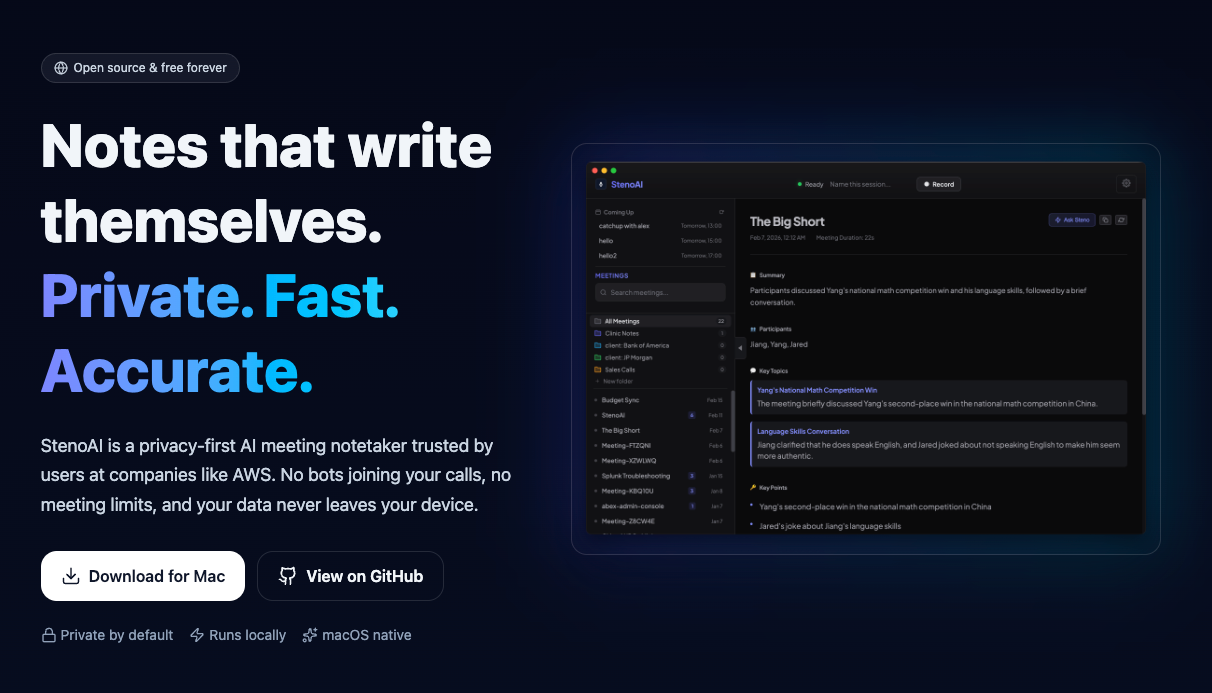
Open-source, privacy-focused meeting transcription and note-taking app that runs locally on your Mac. Record meetings, get real-time transcriptions, and generate AI summaries—all without sending your data to external servers. Built with Whisper for speech-to-text and local LLM integration for summarization. The kind of tool that would have been a $20/month SaaS two years ago, now available for free because someone spent a weekend with an LLM and decided to share it. Another example of vibe-coded open source eating the paid utility market from below.
CameraGraph — Virtual Production Studio for Mac
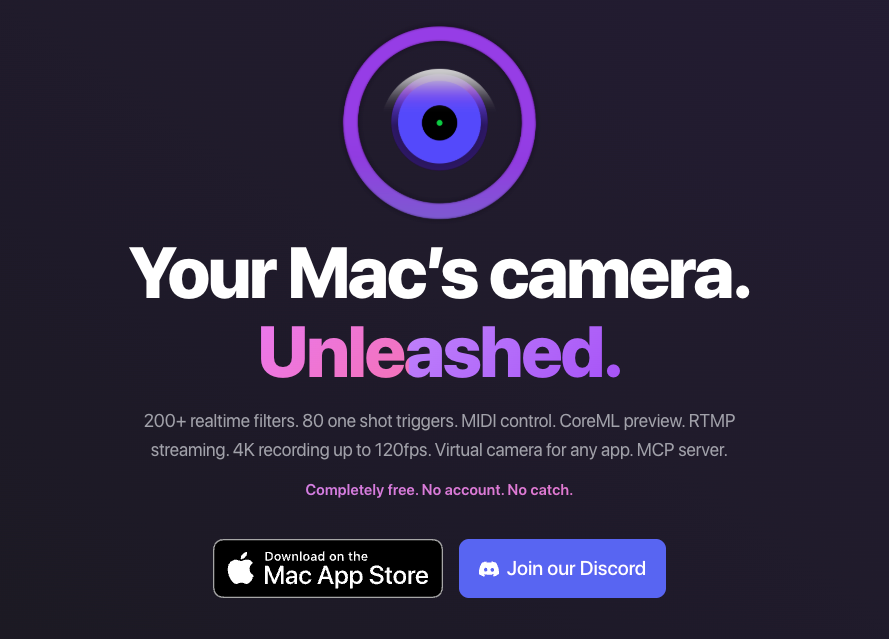
200+ realtime filters, 4K recording at 120fps, RTMP streaming, MIDI control, CoreML model preview, virtual camera output, and MCP server integration. Completely free. This is the app that perfectly illustrates the extinction event—it’s the feature set of ScreenFlow, Ecamm Live, and Loom combined, built by someone who probably spent a few weeks with an LLM and decided to just give it away. No account required, no paywalls, no catch. The kind of thing that would have been $199 perpetual or $30/month SaaS in 2022. Now it’s free on the Mac App Store because the cost of building it dropped below the threshold where charging makes sense. Legacy screen recording and streaming tools are watching their moat evaporate in real time.
Mockdown — ASCII Wireframe Editor
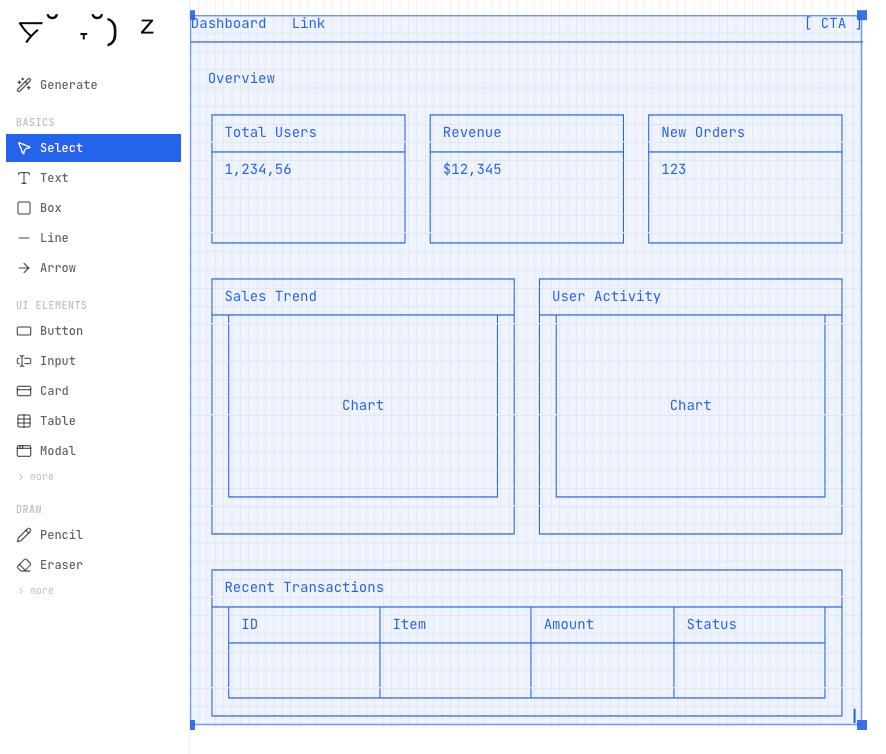
A browser-based tool for sketching wireframes using nothing but ASCII characters—boxes, lines, and text arranged into interface layouts. It’s wonderfully lo-fi: no colors, no fonts, no gradients, just the structural bones of an idea rendered in monospace. Perfect for early-stage thinking when pixel-perfect mockups would be premature, or for designers who want version-controllable wireframes that live as plain text. Draw UI elements, save as text files, share via Markdown. Brutally simple, deliberately constrained, surprisingly effective.
Today’s Vibes
Fort Romeau — Empire
Slow-motion euphoria built from glacial synth pads and a kick drum that lands like a hammer on cathedral stone. “Empire” is patient house music for empty gallery spaces-minimal percussion lets the harmony breathe, every chord change arriving with the weight of inevitability. The arrangement unfolds like dawn through fog, warmth seeping through without ever breaking into full daylight.
Mirrorring — Cliffs
Jesy Fortino and Liz Harris dissolve into each other across windswept expanse. Vocals drift like weather patterns-half-sung, half-exhaled-while guitar and organ blur into granular textures that feel more geology than melody. “Cliffs” is ambient folk for the edge of the continent, where land memory and echo replace structure. Devotional without gods, lonely without longing.
Loscil — Hastings Sunrise
Named for a Vancouver neighborhood where early light breaks over industrial coastline and residential quiet. Scott Morgan’s ambient architecture unfolds in glacial drift—low-frequency rumble beneath crystalline textures that could be dawn refracted through marine layer, or memory dissolving into static. Each sound hovers long enough to feel structural before evaporating. The kind of track that turns a room into a liminal space between sleep and waking, where the outside world presses against glass but never quite breaks through.
Watched